Nissan Patrol Buyer Guide: 4.0 V6 Y62 Compared Across Two Market Specifications
Comparing two Y62 Nissan Patrols photographed for this guide — a 2017 4.0 listed as a US-specification car in white, with an aftermarket body kit and red leather, and a 2018 4.0 Middle East specification in black: what the VQ40DE V6, seven-speed automatic and permanent four-wheel drive deliver, why the 4.0 is the value engine beside the 5.6 V8, how seven- and eight-seat registrations and 100- or 140-litre fuel systems vary by market, what a used Patrol must be inspected for, and how to verify parallel-import spec labels against the VIN before export.
The Other Full-Size SUV the Gulf Trusts
Ask a fleet manager in the Gulf, Central Asia or West Africa which large SUV survives the desert and the workshop, and two names come back: the Toyota Land Cruiser and the Nissan Patrol. The Patrol has been in production since 1951 and is now in its sixth generation, the Y62: a body-on-frame wagon with a 4.0-litre V6 or 5.6-litre V8, permanent four-wheel drive and room for eight.
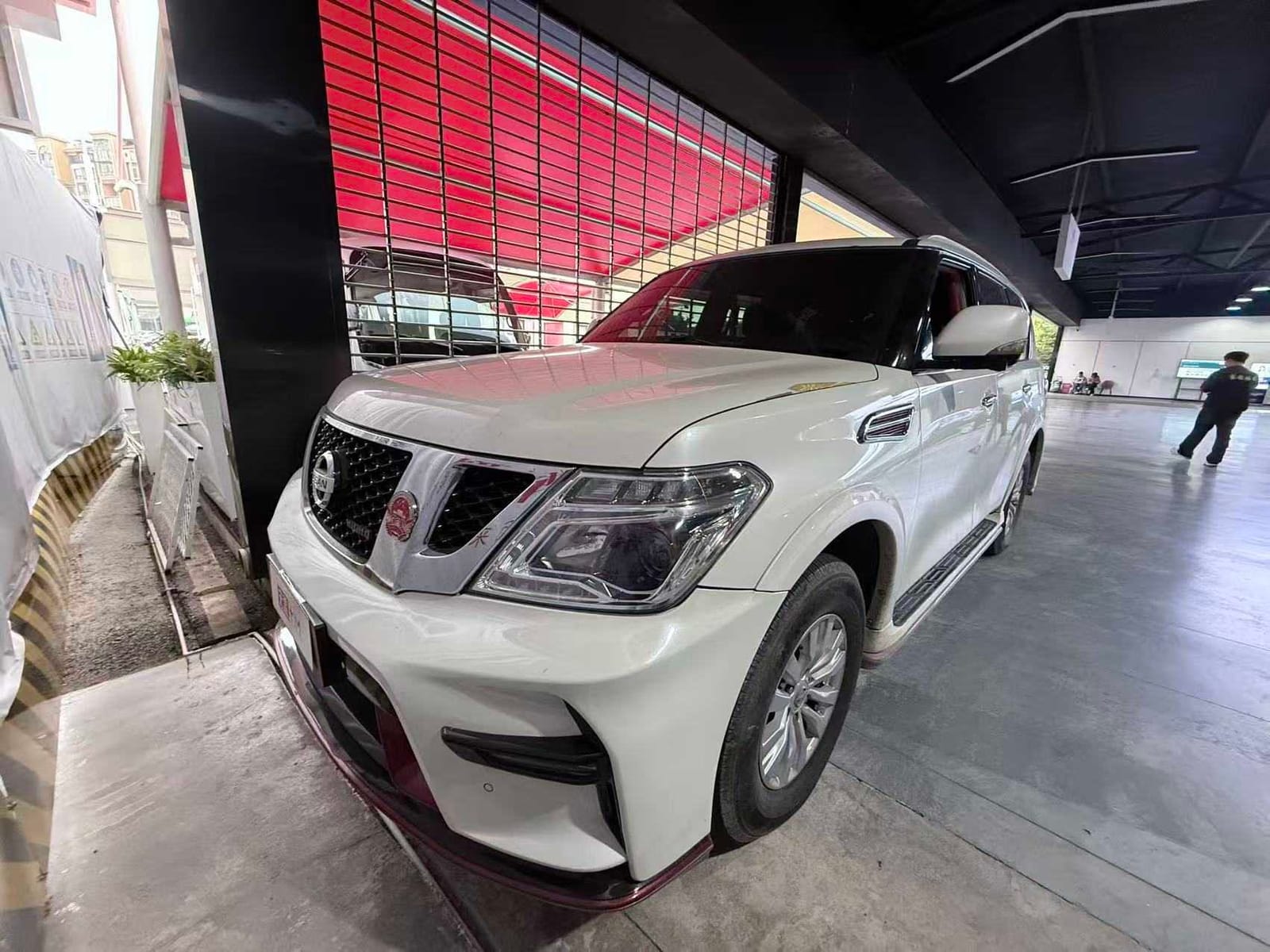
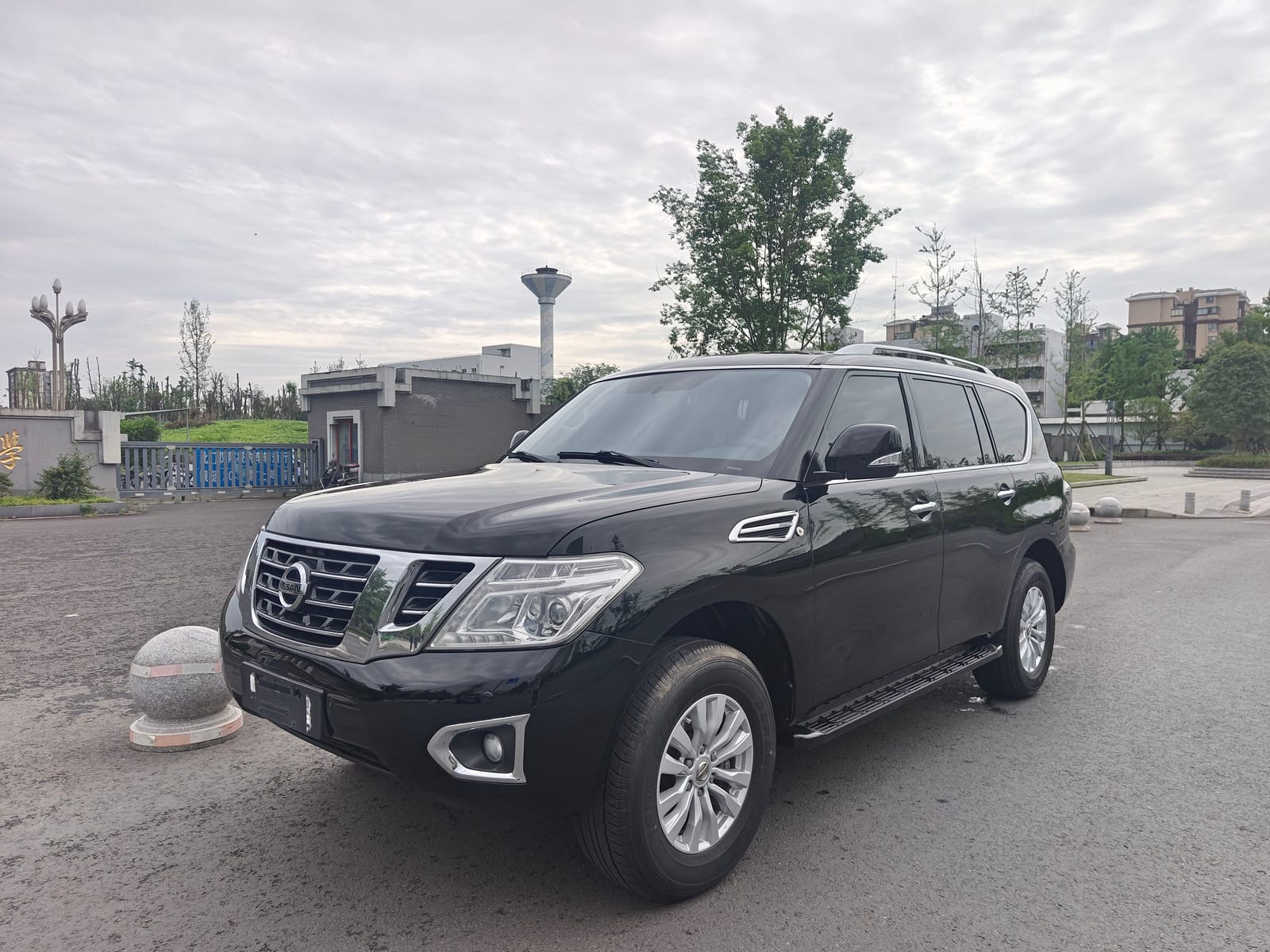
The two cars photographed for this guide are both Y62 Patrols with the 4.0-litre engine. The first is a 2017 Patrol 4.0, listed as a US-specification car, white, with a red leather interior and an aftermarket body kit. The second is a 2018 Patrol 4.0 Middle East specification, black, with the standard grey cloth cabin. They are close relatives, but they show two different routes into the used market — and two different sets of things to verify.
What the Y62 Is, and Where It Sits
The Y62 arrived in 2010 as a clean-sheet replacement for the live-axle Y61. It switched to independent suspension at both ends, a seven-speed automatic and a much larger, more luxurious body, while keeping the ladder frame, the low-range transfer case and the tow-and-desert brief. A 2014 facelift brought the chrome-heavy front end seen on both cars here, and the Y62 remained on sale in many markets until the Y63 successor arrived in 2024.
Three generations overlap in the used market:
- The Y61 (1997–2010s, still built for some fleets) is the old live-axle Patrol, simpler and more agricultural.
- The Y62 (2010–2024) is the independent-suspension car covered here.
- The Y63 (2024 onward) uses turbocharged V6 power and a nine-speed automatic.
The Y62 is now used-only in most export markets, but well supported: parts are shared with the North American Nissan Armada, and independent workshops from Dubai to Almaty know it.
Engine and Drivetrain
The 4.0-litre VQ40DE is a naturally aspirated V6 with 279 PS (205 kW) at 5,600 rpm and 394 Nm at 4,000 rpm. Power builds smoothly, the torque peak is low enough for crawling and towing, and the engine has a long record in Patrols and Navaras. It is matched to a seven-speed torque-converter automatic and permanent four-wheel drive with a two-speed transfer case.
Nissan also sold the Y62 with the 5.6-litre VK56VD V8, rated around 405 PS and 560 Nm, with a 140-litre fuel system and a 3,500 kg braked towing rating in several markets. The V8 is faster, thirstier and more expensive; the 4.0 is the value choice most Gulf fleets bought.
The 4.0 is specified for 95-octane fuel in Chinese configuration tables, and official NEDC consumption is 11.9 litres per 100 km — a laboratory figure real driving will not repeat. Expect much higher consumption in city traffic or with a full load, and treat the 95-octane requirement as a real constraint where fuel quality is poor.
Four-wheel drive is permanent, with high and low ranges. Some trims add a locking rear differential; the two cars photographed are not confirmed to have one, so check the axle specification on the exact vehicle. Ground clearance is quoted around 273 mm and wading depth at 700 mm in Nissan's literature, making the Patrol a genuine desert and flood-season vehicle rather than a soft-roader.
The Two Cars in the Photographs
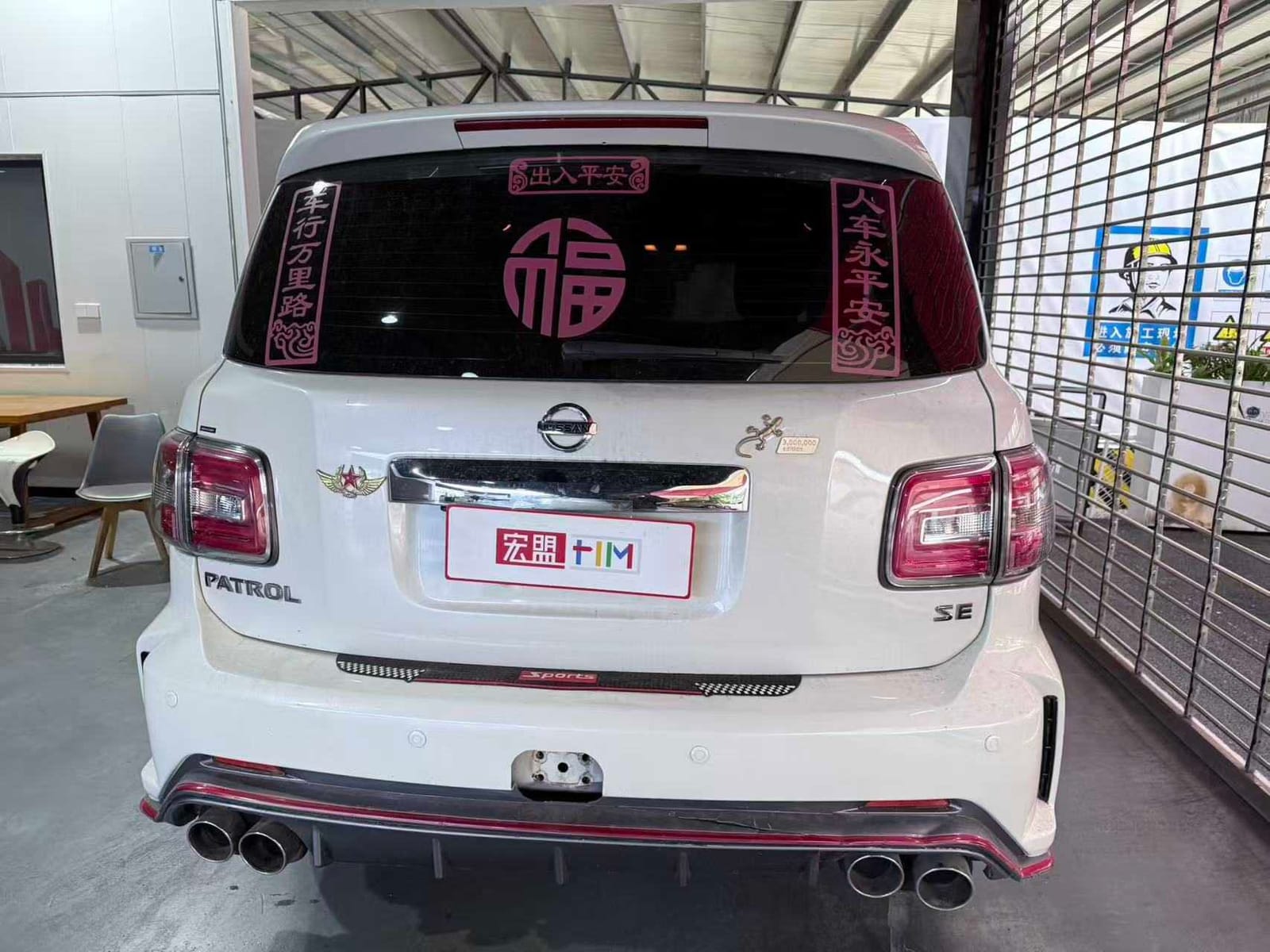
The white car is the more personalised. Its cabin has been retrimmed in bright red leather, including seats, door cards and floor covering, and the exterior carries a body kit, rear spoiler, quad exhaust tips and several decals. The tailgate wears an SE badge, a Middle East trim designation — a useful reminder that Chinese parallel-import listings use "US specification" and "Middle East specification" loosely. Establish what a car actually is from the VIN, build sheet and market code.
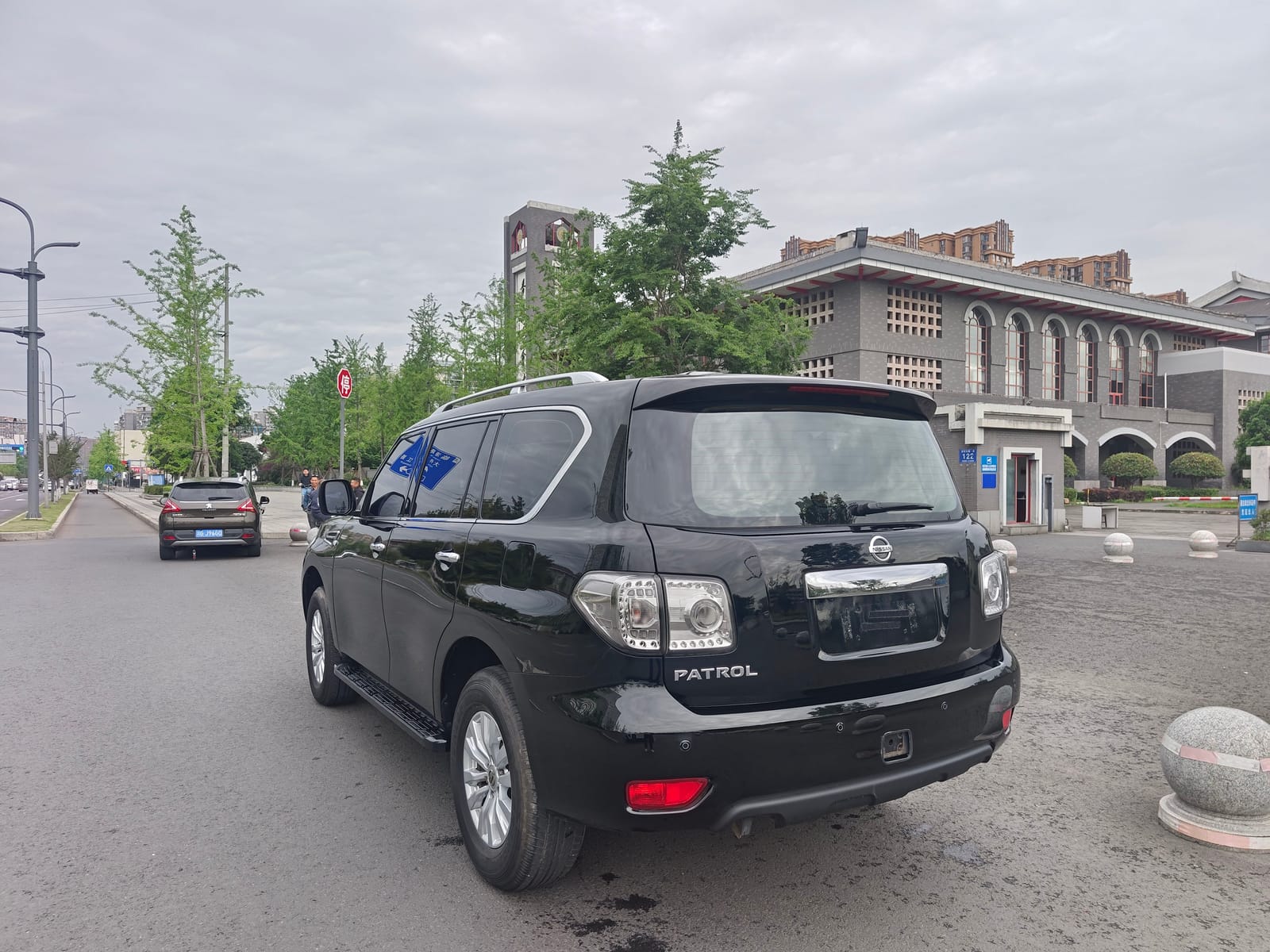
The black car presents as a standard Middle East example: grey cloth seats, unpainted bumpers, original alloy wheels, no body kit. Its listing records Euro 6 emissions, the white car's Euro 5 — a difference worth confirming on the certificates, because import rules often turn on exactly this point.
For a buyer, the white car's aftermarket work changes the inspection. Retrimmed leather needs checking for fit, stitching, airbag seams and water traps; body kits for accident repair hidden underneath and paint match; aftermarket exhausts for corrosion and noise compliance. The black car's originality makes accident and paint inspection easier, but does not remove the need for a mechanical check.
Body, Space and Daily Use
The Y62 is large in every dimension: roughly 5.16 metres long, 2.0 metres wide and 1.94 metres tall, on a 3,075 mm wheelbase. The body is an eight-seat layout, usually 2+3+3, and many Chinese-market cars are registered as seven-seat vehicles even though the third row is present — a paperwork distinction that matters at import.
The cabin is usable for eight adults on short trips and six on long ones. The third row folds, the second row is a bench with a fold-down centre armrest, and the load bay grows large with the seats down.
Fuel capacity depends on market and trim. Chinese tables for the 4.0 list a 100-litre tank; Middle East examples are commonly quoted with a 100-litre main tank plus a 40-litre auxiliary tank, 140 litres in total. Confirm the tank configuration on the individual car — it changes touring range significantly.
Living With It
The Patrol drives like what it is: a heavy ladder-frame SUV with a comfortable ride, light steering and a lot of body movement. It is easy to place in a straight line and less happy in tight car parks. The 4.0 is adequate rather than quick; loaded with eight people it keeps up with traffic but will not surprise anyone.
Two practical points recur in export use. Cooling is one: the air-conditioning and engine cooling systems are heavily loaded in hot climates, and neglected coolant, fans or condensers show up quickly. Tyres are the other: cheap mismatched tyres are common on used examples and affect both safety and ride.
What a Used Patrol Inspection Must Cover
Frame and underbody. Check the rails, body mounts, crossmembers and rear axle area for rust, impact damage and fresh underseal. On a car with a body kit, look behind the covers; on a desert car, look for sand ingress and corrosion around the rear arches.
Engine. The VQ40DE is durable but not indestructible. Check for oil leaks at the valve covers, timing covers and sump, listen for chain noise on cold start, inspect the cooling system and belts, and scan for stored faults.
Transmission. The seven-speed automatic should shift smoothly cold and hot. Test for flare, shudder, delayed engagement and harsh downshifts, check fluid condition and history, and scan the transmission controller.
Four-wheel drive and axles. Engage high and low range on a loose surface and listen for noise or slow engagement. Check both differentials for leaks and whine, confirm whether the car has a rear differential lock, and inspect the propeller shafts and CV boots.
Suspension and steering. Independent suspension at both ends means many bushes, ball joints and links. On a lift, check for play, split boots and leaking dampers; check the rear springs for sag; inspect the steering rack and tie-rod ends.
Body, interior, electrics and paperwork. Test every window, mirror, seat motor, sunroof, camera, sensor and rear air-conditioning control; check seals, third-row mechanisms and aftermarket trim; verify both keys and the toolkit. Then match the VIN to the registration certificate, build sheet and market specification, and confirm emissions class, registered seating capacity and any declared modifications — especially on parallel-import cars with mixed trim badges.
Export Paperwork and Who the Car Suits
All Chinese-market Patrols are left-hand drive, which suits the Middle East, Central Asia, Africa, Russia and Latin America in principle; actual eligibility depends on the destination's emissions and registration rules. The white car records Euro 5 and the black car Euro 6 — confirm the certificates, because some markets accept one and not the other.
The export file should include the registration certificate, factory specification sheet, purchase invoice, export licence documentation, customs declaration, service records and an independent inspection report. Photograph the VIN plate, engine number and odometer, and declare any auxiliary tank or aftermarket body parts.
The Patrol suits fleet, family, mining, oilfield, NGO and desert-touring buyers who need eight seats, real off-road ability and mechanical simplicity, and who have access to 95-octane fuel and a workshop that knows the model. It does not suit buyers who want low fuel consumption, tight-city manoeuvrability or a modern connected cabin.
Buyer Questions
Is the Patrol the same class as a Land Cruiser? Yes — Nissan's full-size counterpart to the Land Cruiser 200/300, with a similar ladder-frame layout, permanent four-wheel drive and eight-seat body. The Land Cruiser has the stronger global parts and resale story; the Patrol is usually cheaper to buy used.
Should I choose the 4.0 V6 or the 5.6 V8? The 4.0 is cheaper to buy and run, easier to fuel in remote markets and adequate for most work. The V8 is faster, thirstier and more expensive, with a larger fuel system and higher towing ratings in some markets.
How many seats does it really have? The Y62 body is an eight-seat design; Chinese-market registrations often show seven. Confirm the registration and the physical third row, and check what the destination accepts.
What fuel does the 4.0 need? Chinese specification tables call for 95-octane. Where that is unavailable, the knock-control system may tolerate lower grades, but sustained use risks performance loss and damage.
Are "US specification" and "Middle East specification" reliable labels? Not always. The white car carries a Middle East SE badge despite its listing. Verify the VIN and build sheet rather than trusting the label.
Next Step
Tell us which Patrol you are considering and how it will be used — family, fleet, desert touring, oilfield or mining support — and we will send the file for that car: the full inspection report, factory specification sheet, cold-start and driving video, close-ups of the frame, axles and body kit, an honest assessment of the emissions and registration route into your market, and our export documents. If you are choosing between the white and black cars here, say so, and we will compare their actual specifications, not their listing labels.
Lexus LX Buyer Guide: 2019 LX 570 V8 vs 2022 LX 600 Twin-Turbo
Product Research Team
Range Rover Buyer Guide: 2019 Supercharged V6 vs 2022 Ingenium Inline-Six
Product Research Team
Land Rover Defender Buyer Guide: 2023 HSE vs 2025 X-Dynamic Black Compared
Product Research Team