China's Used Light Trucks Get a Factory-Backed Export Channel
On 28 October 2026 Dongfeng Automobile held the first export promotion event for used light trucks at the Wuhan Airport Economic Zone bonded area, and the event was reported by Xinhua on 3 November. The company says the full chain — evaluation, reconditioning, inspection and bonded supervision — was proven with a first vehicle by the end of September, with grading of used units, 31 functional plus 20 value-added reconditioning items, an extended warranty underwritten with PICC starting at 180 days, and agreements with traders in Ghana, Côte d'Ivoire and Nigeria. The stated targets are 3,000 units next year and around 10,000 a year in the longer term. For buyers, the interesting part is the warranty and grading, not the ceremony.
What Happened
On 28 October 2026 Dongfeng Automobile, the listed commercial vehicle arm of the Dongfeng group, held its first export promotion event for used light trucks at the Wuhan Airport Economic Zone bonded area. Xinhua reported the event on 3 November.
The event was not a launch in the usual sense. It was the point at which a project started in June was declared ready: by the end of September, the company says, a first used light truck had gone through evaluation, reconditioning, inspection and acceptance, proving the whole chain inside the bonded zone.
Hubei provincial commerce, market supervision and Hankou Customs officials took part, and agreements were signed with used-vehicle traders from Ghana, Côte d'Ivoire and Nigeria as well as domestic partners.
Why Light Trucks
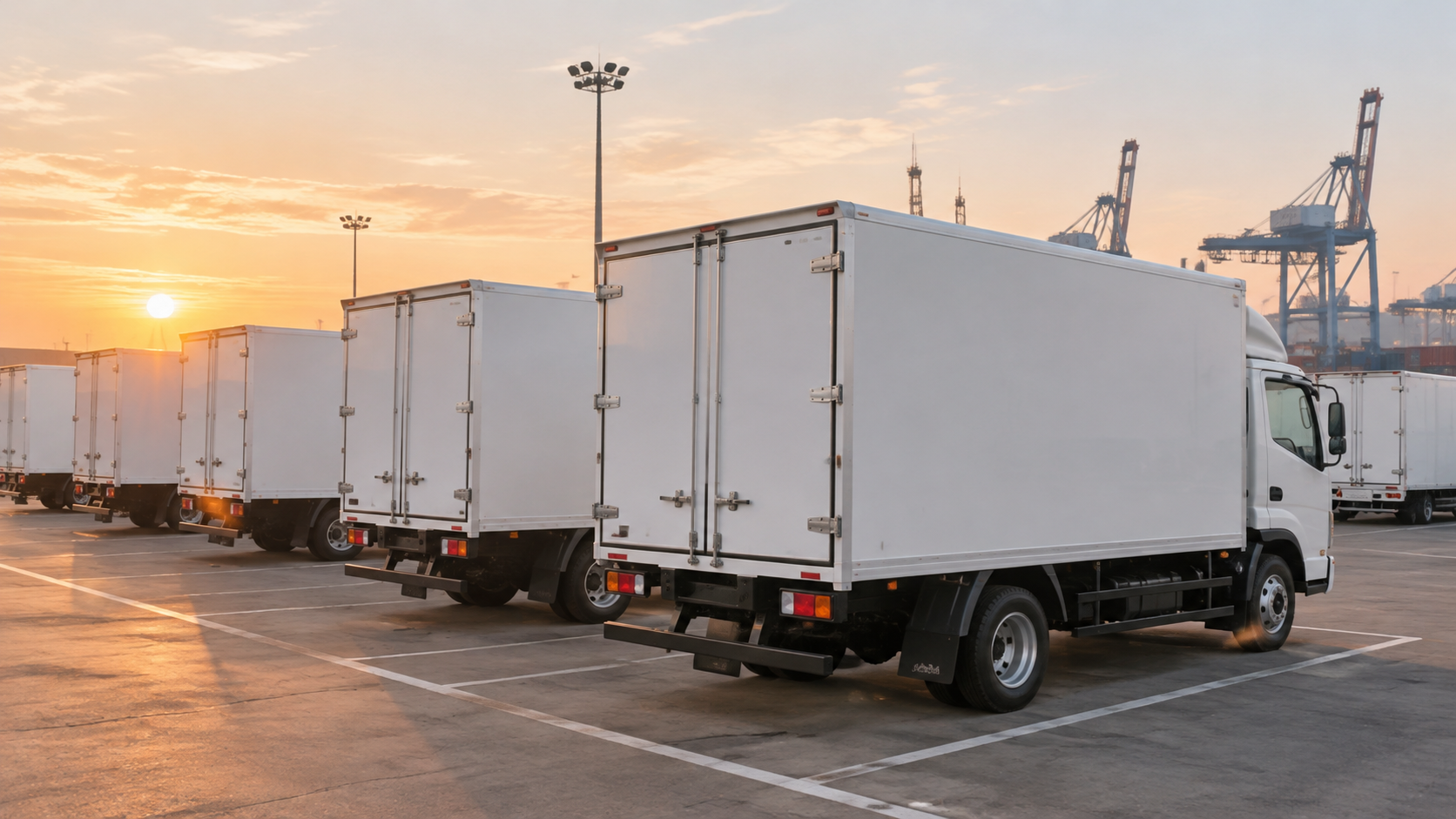
Passenger cars dominate coverage of Chinese used-car exports, but light trucks are a different market with different buyers: small fleets, builders' merchants, distributors and municipal contractors in West Africa, South America, the Middle East and Southeast Asia.
For those buyers, the appeal of a used Chinese light truck is simple. They are cheap to buy, mechanically straightforward, and built for overloaded roads and poor fuel. The weakness has always been the other side of the deal: no warranty, uncertain history, and parts that arrive late or not at all.
A factory-backed channel is an attempt to fix the second half. Dongfeng says it has built its export programme around four controls.
The Four Controls
1. Evaluation. Vehicles are screened using maintenance and accident data, with the company describing checks aimed at clocked cars and written-off cars, an AI valuation model trained on more than 100,000 transactions a year, and judicial appraisers involved in the process.
2. Reconditioning. Used vehicles are graded into condition tiers, then reconditioned against a fixed list: 31 functional items and 20 added-value items, according to the company. Each vehicle is said to ship with a spare-parts kit and tools.
3. Warranty. Dongfeng has partnered with PICC on an overseas extended warranty covering the engine, gearbox and chassis, starting at 180 days and configurable up to nine or twelve months.
4. Supervision. The inspection centre sits at the bonded zone customs port, with an electronic fence around the yard, so vehicles cannot leave the supervised area without clearance.
Targets and Scale
The company says vehicles will go first to West Africa, South America, the Middle East and Southeast Asia. It has set a target of 3,000 used light trucks next year and a longer-term ambition of around 10,000 a year.
It also cites roughly 450 overseas service stations and six training centres in its commercial vehicle network, with a plan to go beyond 550 stations by the end of the year. Note the caliber: Xinhua describes the network as "close to 500", so the two figures count slightly different things. Treat both as company statements.
For context on how new this trade still is, Hubei province issued 3,021 used-car export licences and exported 4,111 used vehicles in the first ten months of 2026, according to the reports. A single company aiming at 3,000 units next year is aiming at a large share of that provincial flow.
The Policy Backdrop
Since 1 January 2026 a four-ministry notice has tightened used-vehicle exports. Vehicles registered for less than 180 days must come with an after-sales service confirmation letter stamped by the manufacturer, naming the export country and overseas service points, or no export licence is issued. The same notice sets out a negative list of dishonest practices and a mechanism for suspending companies that breach it.
A manufacturer exporting its own used trucks, with its own service network, is exactly the model that notice was designed to encourage. That is the honest way to read this pilot: not a marketing event, but an alignment with rules that now reward factory involvement.
What It Means for Buyers
Warranty is the real product. A 180-day minimum on engine, gearbox and chassis, extendable, is unusual in the used commercial vehicle trade. Ask for the warranty document, the covered components, the claim procedure and who pays for labour in your country.
Grading needs a document, not a slogan. Ask for the inspection report for the specific vehicle: what was found, what was replaced, and which grade it received. There is no public standard here yet, so the report is the evidence.
Parts are the test. A spare-parts kit and a service network matter more than the badge. Check that your model's common failure parts — clutch, brakes, filters, lights — are stocked in your market.
Documents decide legality. The export licence, invoice, certificate and vehicle identification number must agree, and the registration date must be accurate. Emission rules in the destination country are applied per vehicle, against the certificate travelling with it, not by model.
A pilot is not a guarantee. The first vehicles through a new channel are the ones most closely watched, which is good for buyers; later ones deserve the same scrutiny. Inspect the vehicle you are buying, or have it inspected.
Questions to Ask a Supplier
- Is the vehicle inside the bonded-zone supervision programme, and can you show the inspection report?
- Which warranty applies, for how long, and who performs the work in my country?
- Which service points are within reach of my route, and do they stock parts for this model?
- What is the registration date on the certificate, and how does it compare with the listing?
- Which port and shipping line, and who handles the export licence?
What to Watch
- Whether the 3,000-unit target for next year is met, which would show the channel works at volume.
- Whether the grading standard is published, turning a company practice into something a buyer can compare.
- Whether other commercial vehicle makers follow, which would make used trucks a normal export category rather than a pilot.
- Whether overseas warranty claims are actually paid, which is the only real test of the model.
Method Note
Dates and event details come from Xinhua's report of 3 November 2026 and Jimu News reporting of 30 October 2026. Figures for reconditioning items, warranty terms, service points and targets are company statements reported by those outlets, not independently audited data; where the two reports differ in framing, the difference is noted. The Hubei licence and export figures are provincial statistics for January to October 2026 as reported in the same coverage. No estimate is given here for how many used light trucks from this channel are already on the road abroad.
Summary
Dongfeng has turned used light truck exports into a supervised, graded, warranted business, starting with West Africa, South America, the Middle East and Southeast Asia. The numbers are company targets and the grading standard is not yet public, so buyers should treat the warranty and the inspection report as the parts of the offer worth negotiating over. For the used commercial vehicle trade, the significance is that a manufacturer is now standing behind the vehicle after it leaves China.