BAIC BJ40 PLUS Buyer Guide: 2018 2.0T City Hunter and the Body-on-Frame 4WD to Inspect
A buyer guide to the BAIC BJ40 PLUS, built around a photographed 2018 2.0T City Hunter 4WD in black. Unlike the road-first crossovers elsewhere in this guide, the BJ40 is a genuine body-on-frame off-roader: a ladder frame, a part-time 4WD system with a low-range transfer case, a five-link solid rear axle, 210 mm of ground clearance and 750 mm of wading depth. This guide explains the 2.0T + six-speed automatic powertrain, why the PLUS generation matters, the chassis numbers, what a used example must be inspected for — starting with the frame — who it suits, and the export document trail.
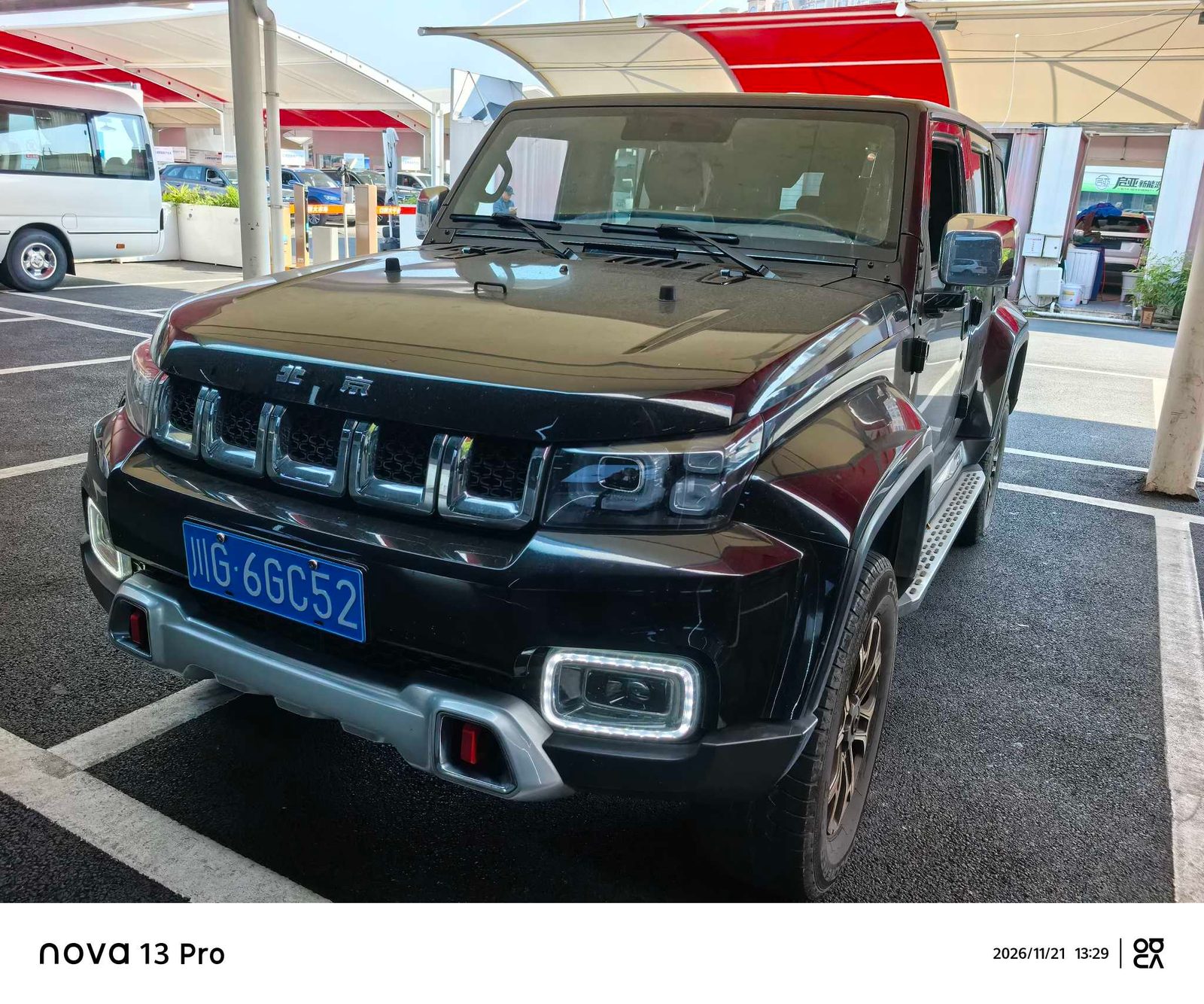
BAIC's Body-on-Frame Off-Roader
The BJ40 is the SUV that put BAIC's off-road division (北京越野, "Beijing Off-Road") on the map: a body-on-frame, part-time four-wheel-drive off-roader whose boxy, seven-slot silhouette is openly inspired by the Jeep Wrangler. Where the crossovers covered elsewhere in this guide are road-first vehicles, the BJ40 is a genuine off-road platform — a ladder frame, a two-speed transfer case and a solid rear axle.
The car photographed here is a 2018 BAIC BJ40 PLUS 2.0T City Hunter 4WD in black. The "PLUS" matters: it is the 2018 rework that widened the track, softened the ride and added interior comfort, turning a spartan off-road tool into something a family could live with daily — the "City Hunter" trim is the road-friendly end of that range.
Where the BJ40 Sits
BAIC's off-road line-up is built around the BJ40 as its volume model, sitting below the larger BJ60 and BJ80. It is the entry point to a genuine ladder-frame 4WD. Two generations overlap in the used market: the original BJ40 (2013-2017) and the BJ40 PLUS (2018 onward) shown here.
The PLUS changed enough to matter: a wider track for better stability, an independent double-wishbone front suspension, a five-link solid rear axle, and a more finished interior. For a used buyer, "PLUS" is the generation to prefer.
It is not a crossover. The BJ40 keeps a separate ladder frame, a part-time 4WD system with a low-range transfer case, and a 210 mm minimum ground clearance with a 750 mm wading depth. Those are the numbers that separate it from every car-based SUV.
The 2.0T Powertrain
The City Hunter carries a 2.0-litre turbocharged inline-four making 218 PS (160 kW) at 5,500 rpm and 320 N·m from 1,750 to 4,500 rpm, with direct injection. It is tuned for 95-octane petrol — a genuine running-cost difference against the 92-octane crossovers.
The gearbox is a six-speed automatic, sourced in many sources from ZF. A conventional torque-converter automatic suits both highway cruising and low-speed off-road work better than a dual-clutch, and it removes the clutch-wear concern entirely.
Fuel consumption is the price of the architecture: a 2.1-tonne body-on-frame 4WD drinks around 10.1 L/100 km on the NEDC cycle. Buyers who want the off-road capability accept this; buyers who only drive on-road should reconsider.
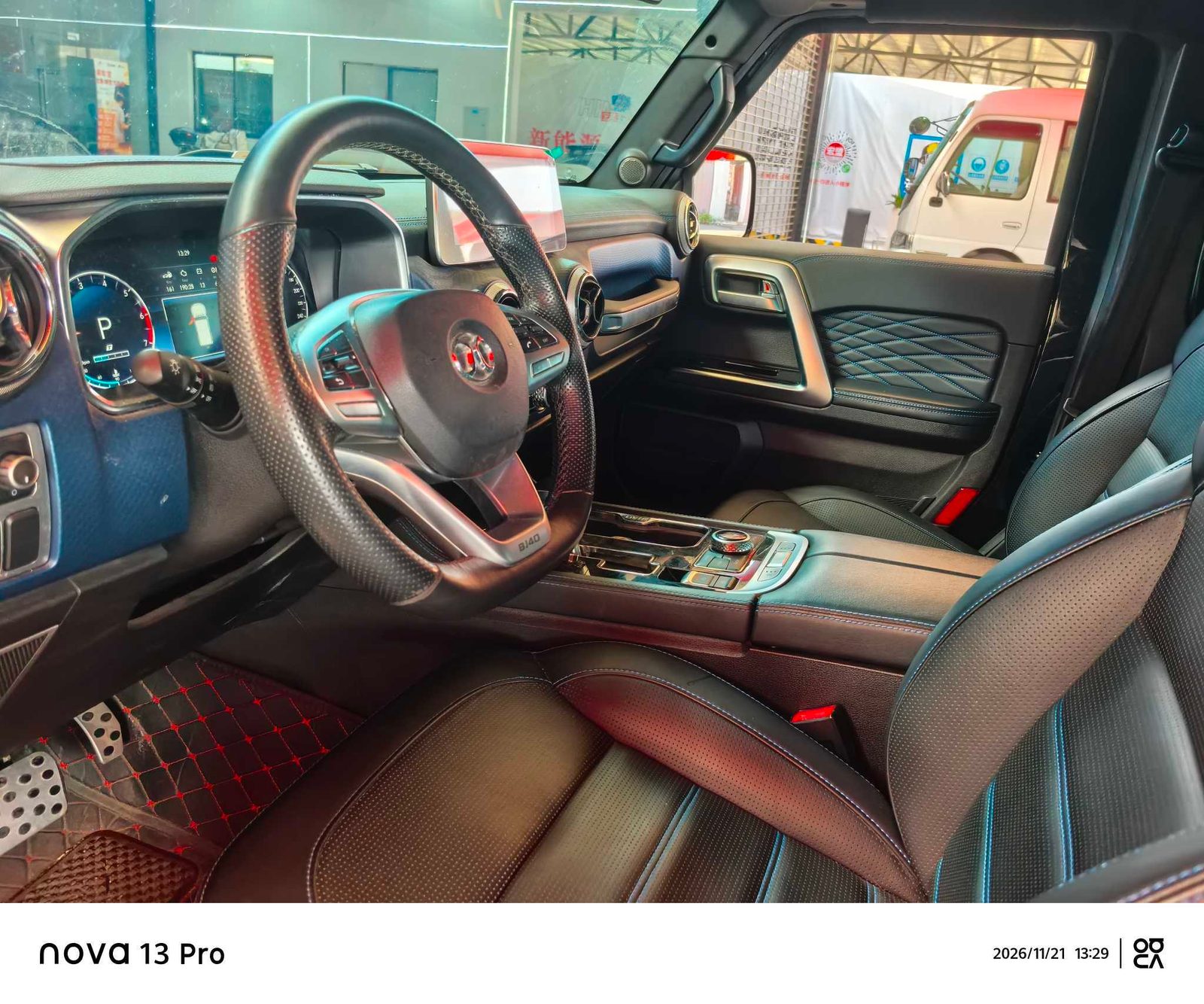
Chassis and Off-Road Numbers
| Item | Specification |
|---|---|
| Length / width / height | 4,645 / 1,925 / 1,871 mm |
| Wheelbase | 2,745 mm |
| Body | 4-door, 5-seat body-on-frame SUV |
| Kerb weight | ~2,110 kg |
| Front / rear suspension | Double-wishbone independent / five-link solid axle |
| Drivetrain | Part-time 4WD with low-range transfer case |
| Min ground clearance | 210 mm |
| Approach / departure angle | 37° / 31° |
| Max wading depth | 750 mm |
| Tyres | 265/65 R17 |
| Fuel tank | 75 L |
The chassis is the story. A body-on-frame layout with a five-link solid rear axle and a low-range transfer case is the classic off-road recipe — the same family of engineering as a Wrangler or a Prado, not a monocoque crossover. The 37° approach and 31° departure angles and the 750 mm wading depth are genuine off-road credentials, not styling claims.
That capability has a daily cost: body-on-frame vehicles are heavier, thirstier and less refined on-road than a monocoque SUV. The BJ40 PLUS narrowed that gap, but it did not close it.
What to Inspect on a Used BJ40
1. The frame, first. A body-on-frame 4WD lives or dies by its chassis. Inspect the ladder frame for corrosion, crash repair and off-road damage — bent crossmembers, repaired mounts, heavy rust along the rails. This matters more than the bodywork.
2. The 4WD system. Engage 2H, 4H and 4L and confirm the transfer case shifts cleanly, the front axle engages and disengages, and there are no driveline clunks. A part-time 4WD used hard will show wear in the transfer case and front hubs.
3. The solid rear axle and suspension. Check the five-link rear for worn bushings, leaking dampers and play, and the double-wishbone front for the same. Off-road use accelerates all of it.
4. The 2.0T and its service. The turbocharged, direct-injection engine punishes skipped oil changes. Check for oil residue around the turbo and intercooler, and ask for service history.
5. Off-road wear generally. Look at the tyres for off-road cuts, the underbody for rock damage, and the interior for the dust and wear that come from genuine trail use.
Who the BJ40 Suits, and Where It Exports
The BJ40 is for buyers who genuinely need or want a ladder-frame 4WD — not a crossover. It suits:
- Off-road and overland buyers — the frame, low-range transfer case and ground clearance are the real thing.
- Export markets with rough roads — Russia, Central Asia, the Middle East and parts of Africa and Latin America, where a body-on-frame 4WD has genuine utility.
- Buyers who want Wrangler-style capability at a China price — the BJ40 is the closest thing in the Chinese market.
It is not the car for a purely on-road, fuel-conscious buyer: the 95-octane requirement and 10 L/100 km consumption are the honest cost of the capability.
Export Documents and Compliance
Exporting a used BJ40 follows the standard China used-car trail: export licence, registration certificate and cancellation, commercial invoice and packing list, certificate of origin, and destination compliance (emissions class, left/right-hand-drive, lighting, and the after-sales confirmation for recently registered vehicles).
Because the BJ40 is a Chinese-market vehicle rather than a global product, homologation and parts in some destinations require more care than a globally-badged model — confirm with the importer before committing.
Questions Buyers Ask
Is it a real off-roader? Yes. Body-on-frame, part-time 4WD with low range, solid rear axle, 210 mm clearance, 750 mm wading. It is a genuine 4WD, not a crossover with cladding.
City Hunter or a crossover? If you only drive on-road, buy a crossover — it will be more refined and cheaper to run. Buy a BJ40 because you want the frame and the low-range transfer case.
95-octane and 10 L/100 km — worth it? That is the cost of a 2.1-tonne ladder-frame 4WD. Worth it if the off-road capability earns its keep; not if the car never leaves tarmac.
What about the 6AT? The ZF-sourced six-speed automatic is a strength — a conventional torque-converter box that suits both highway and low-speed off-road work, with none of the dual-clutch concerns.
PLUS or the original BJ40? Prefer the PLUS: wider track, better front suspension, more finished interior, and the automatic gearbox.
Next Step
If a genuine body-on-frame 4WD with low-range capability is what you need — for rough-road export markets or real off-road use — the BAIC BJ40 PLUS is one of the few Chinese options in that class, and a sensible one if the frame and 4WD system are properly inspected. The black 2018 2.0T City Hunter shown here is the road-friendly end of a serious off-road platform.
Tell us the destination country and the target spec, and we will match you to an inspected in-stock BJ40 — with the export documents, compliance check and shipping handled end to end.
Buick Envision Buyer Guide: 2020 20T 1.5T and the Dry-DCT You Must Inspect
Product Research Team
JETOUR Dashing Buyer Guide: 2026 1.5T Youth Edition Elite vs 2023 Star PRO
Product Research Team
Lexus LX Buyer Guide: 2019 LX 570 V8 vs 2022 LX 600 Twin-Turbo
Product Research Team